NEWYou can now listen to Fox News articles!
Losing the ability to speak clearly after a stroke can feel devastating. For many survivors, the words are still there in their minds, but their bodies will not cooperate. Speech becomes slow, unclear or fragmented. This condition, known as dysarthria, affects nearly half of all stroke survivors and can make everyday communication exhausting. Now, researchers believe they may have found a better way forward. Scientists at the University of Cambridge have developed a wearable device called Revoice. It is designed to help people with post-stroke speech impairment communicate naturally again without surgery or brain implants.
Sign up for my FREE CyberGuy Report
Get my best tech tips, urgent security alerts, and exclusive deals delivered straight to your inbox. Plus, you’ll get instant access to my Ultimate Scam Survival Guide — free when you join my CYBERGUY.COM newsletter.
FULLY IMPLANTABLE BRAIN CHIP AIMS TO RESTORE REAL SPEECH
A soft, flexible choker like this houses Revoice’s sensors, which read subtle throat vibrations to help reconstruct speech in real time. (University of Cambridge)
Why dysarthria makes recovery so hard
Dysarthria is a physical speech disorder. A stroke can weaken the muscles in the face, mouth and vocal cords. As a result, speech may sound slurred, slow or incomplete. Many people can only say a few words at a time, even though they know exactly what they want to say. According to professor Luigi Occhipinti, that disconnect creates deep frustration. Stroke survivors often work with speech therapists using repetitive drills. These exercises help over time, but open-ended conversation remains difficult. Recovery can take months or even longer, which leaves patients struggling during daily interactions with family, caregivers and doctors.
How the Revoice device works
Revoice takes a very different approach. Instead of asking users to type, track their eyes or rely on implants, the device reads subtle physical signals from the throat and neck. It looks like a soft, flexible choker made from breathable, washable fabric. Inside are ultra-sensitive textile strain sensors and a small wireless circuit board. When a user silently mouths words, the sensors detect tiny vibrations in the throat muscles. At the same time, the device measures pulse signals in the neck to estimate emotional state.
Those signals are processed by two artificial intelligence (AI) agents:
- One reconstructs words from mouthed speech
- The other interprets emotion and context to build complete sentences
Together, they allow Revoice to turn a few mouthed words into fluent speech in real time.
ELON MUSK SHARES PLAN TO MASS-PRODUCE BRAIN IMPLANTS FOR PARALYSIS, NEUROLOGICAL DISEASE
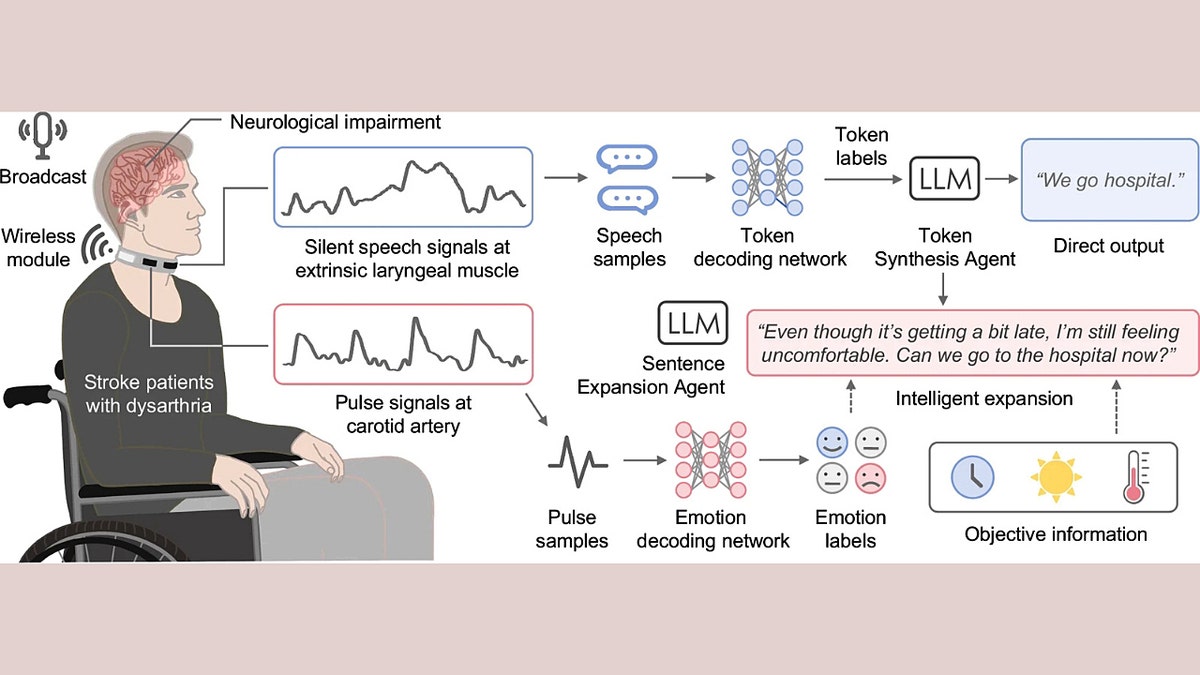
This diagram shows how Revoice combines throat muscle signals and pulse data with AI to turn silently mouthed words into full, expressive sentences in real time. (University of Cambridge)
Why this AI approach is different
Earlier silent speech systems had serious limits. Many were tested only on healthy volunteers. Others forced users to pause for several seconds between words, which made the conversation feel unnatural. Revoice avoids those delays. It uses an AI-driven throat sensor system paired with a lightweight language model. Because the model runs efficiently, it uses very little power and delivers near-instant responses. The device is powered by a 1,800 mWh battery, which researchers expect will last a full day on a single charge.
What early trials revealed
After refining the system with healthy participants, researchers tested Revoice with five stroke patients who had dysarthria.
The results were striking:
- Word error rate: 4.2%
- Sentence error rate: 2.9%
In one example, a patient mouthed the phrase “We go hospital.” Revoice expanded it into a complete sentence that reflected urgency and frustration, based on emotional signals and context. Participants reported a 55% increase in satisfaction and said the device helped them communicate as fluently as they did before their stroke.
PARALYZED MAN WALKS AGAIN AFTER EXPERIMENTAL DRUG TRIAL TRIGGERS REMARKABLE RECOVERY
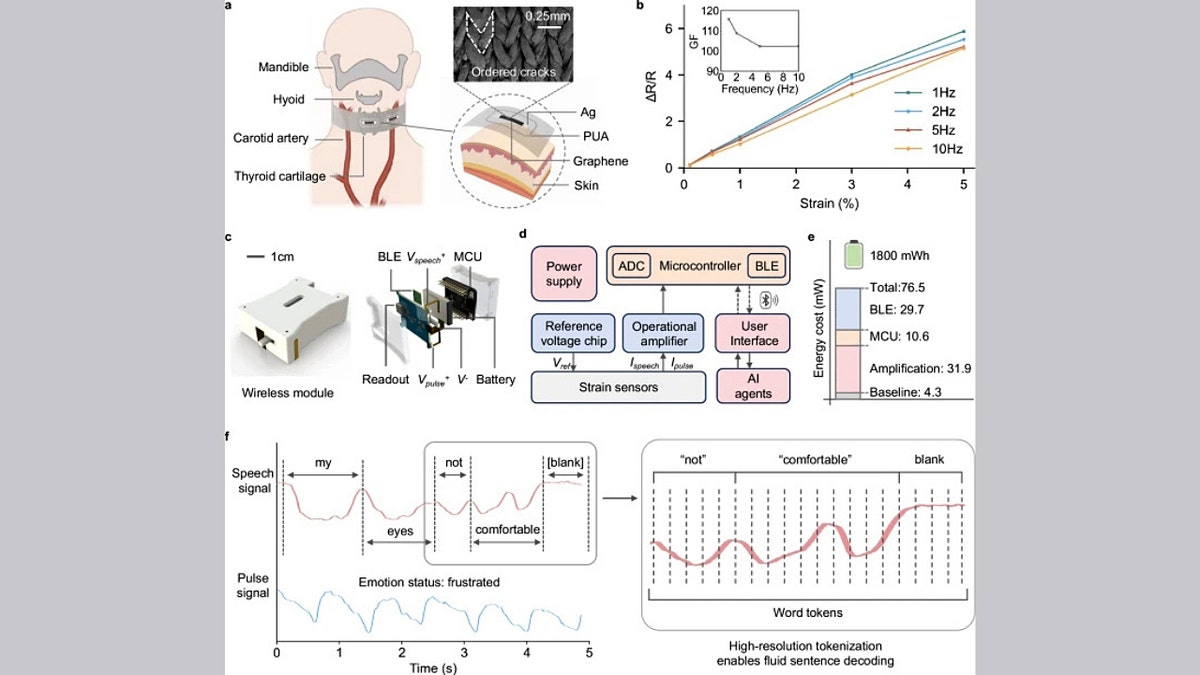
This figure breaks down the Revoice hardware and AI pipeline, showing how strain sensors, wireless electronics, and emotion decoding work together to reconstruct natural speech. (University of Cambridge)
Beyond stroke recovery
Researchers believe Revoice could also help people with Parkinson’s disease and motor neuron disease. Because the device is comfortable, washable, and designed for daily wear, it could fit into real-world routines rather than being confined to clinics. Before that can happen, larger clinical trials are required. The research team plans to begin broader studies with native English-speaking patients and hopes to expand the system to support multiple languages and a wider range of emotional expressions. The findings were published in the journal Nature Communications.
What this means for you
If you or someone you care for has experienced a stroke, this research points to a major shift in recovery tools. Revoice suggests that speech assistance does not need to be invasive to be effective. A wearable solution could support communication during the most difficult months of rehabilitation, when confidence and independence often suffer the most. It may also reduce stress for caregivers who struggle to understand incomplete or unclear speech. Clear communication can improve medical care, emotional well-being and daily decision-making.
Take my quiz: How safe is your online security?
Think your devices and data are truly protected? Take this quick quiz to see where your digital habits stand. From passwords to Wi-Fi settings, you’ll get a personalized breakdown of what you’re doing right and what needs improvement. Take my Quiz here: Cyberguy.com
Kurt’s key takeaways
Communication is tied closely to dignity and independence. For stroke survivors, losing that ability can be one of the hardest parts of recovery. Revoice shows how artificial intelligence and wearable tech can work together to restore something deeply human. While it is still early, this device represents a meaningful step toward making recovery feel less isolating and more hopeful.
If a simple wearable could help restore natural speech, should it become a standard part of stroke rehabilitation? Let us know by writing to us at Cyberguy.com
CLICK HERE TO DOWNLOAD THE FOX NEWS APP
Sign up for my FREE CyberGuy Report
Get my best tech tips, urgent security alerts, and exclusive deals delivered straight to your inbox. Plus, you’ll get instant access to my Ultimate Scam Survival Guide — free when you join my CYBERGUY.COM newsletter.
Copyright 2026 CyberGuy.com. All rights reserved.